
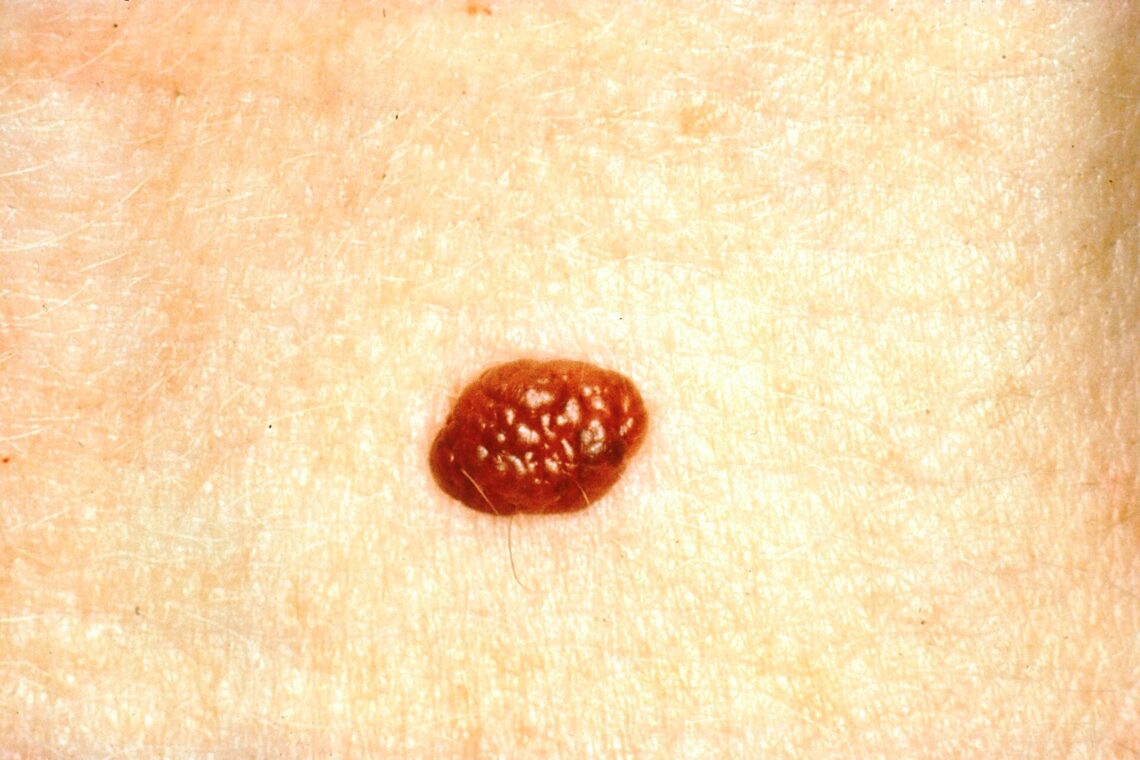
Pigmented Nevus (Mole): Types, Warning Signs and Removal
A pigmented nevus is the medical name for a common mole: a cluster of pigment-producing cells (melanocytes) that forms a brown, tan, black or skin-coloured spot. Most are harmless and stay stable for years. The reason to know about them is simple: melanoma, a serious skin cancer, can start in or look like a mole, so any mole that is new in adulthood, changing, or different from the rest should be checked by a doctor.
What a pigmented nevus is
Melanocytes normally sit spread out along the base of the epidermis. In a nevus, they gather together in nests. Depending on where the nests sit, a mole may be flat or raised, smooth or slightly rough, and lighter or darker. Many moles appear in childhood and early adulthood, often in larger numbers on sun-exposed skin. Over decades, some moles fade or become paler and softer.
Common types
| Type | What it usually looks like | Points to know |
|---|---|---|
| Congenital nevus | Present at birth or soon after, can be small or large | Very large ones carry a higher risk and need regular follow-up |
| Junctional nevus | Flat, evenly brown, round or oval | Common in children and young adults |
| Compound nevus | Slightly raised centre with a flat brown edge | Often develops from a junctional nevus |
| Intradermal nevus | Raised, soft, skin-coloured to light brown, may have hairs | Common on the face in adults |
| Atypical (dysplastic) nevus | Larger, irregular edge or uneven colour | Usually benign, but people with many have higher melanoma risk |
| Blue nevus | Blue-grey, small and firm | Colour comes from pigment deeper in the skin |
| Spitz nevus | Pink or brown dome, often in children | Can resemble melanoma; usually assessed by a specialist |
Only a doctor can tell these apart reliably, often using a dermatoscope, a handheld magnifier with special lighting.
Who has more moles
The number of moles a person has depends on genetics, skin type and sun exposure, especially in childhood. People with lighter skin tend to have more. People with darker skin have fewer moles overall, but melanomas can appear on the palms, soles and under the nails, where they are easy to miss.
Signs that a mole needs checking
- Asymmetry: the two halves do not match
- Border: ragged, notched or blurred edges
- Colour: several shades, or very dark, red, white or blue areas
- Diameter: larger than about 6 mm, though smaller melanomas exist
- Evolving: changing in size, shape, colour or height, or new symptoms such as itching, crusting or bleeding
Also: a mole that looks different from all your others (the “ugly duckling” sign), a new dark streak under a nail, or a sore that does not heal.
How to check your own skin
Once a month, in good light, check your whole body, including the scalp, between toes, soles and palms, and under nails. Use a hand mirror or ask someone to help with your back. Photos taken on your phone of moles you are watching, with a ruler or coin for scale, make it easier to spot change. If you have many moles, a family history of melanoma or a history of severe sunburns, ask a dermatologist about regular skin checks.
What happens at a skin check
The doctor asks about your history, examines your skin and looks closely at selected moles with a dermatoscope. Some clinics use digital mole mapping, which stores images to compare at future visits. If a mole looks suspicious, the doctor will usually recommend removing it, fully or partly, and sending it to a laboratory for examination under a microscope. This is the only way to confirm a diagnosis.
Mole removal: medical and cosmetic
Moles may be removed because they look suspicious, or for comfort and appearance, for example when a raised mole catches on clothing or a razor.
- Surgical excision: the mole is cut out with a margin of skin and stitched. Used when there is any concern about melanoma.
- Shave removal: a raised benign mole is shaved flush with the skin. Mainly cosmetic; the mole can sometimes regrow.
- Laser or cream removal: not advised for moles in general, because no tissue is left to examine, and pigment can be hidden rather than removed.
Avoid home removal
Creams, acids, pens and kits sold online to “remove moles” can burn the skin, leave scars and, most importantly, destroy evidence of a melanoma without treating it. Any removal should be done by a doctor.
A mole that changes is a reason for a doctor, not a lightening cream.
Sun protection and moles
Sun exposure in childhood is linked to developing more moles, and UV exposure raises melanoma risk at any age. In the UAE, where the UV index is high for most of the year, daily broad-spectrum sunscreen, shade, hats and sunglasses are worth the habit. Sunscreen will not make existing moles disappear, but it helps protect your skin overall. Our ingredient pairing chart explains how to layer sunscreen with other products.
Moles and pigmentation treatments
Many people come to clinics wanting to lighten dark spots. It is important that moles are distinguished from other pigmentation, such as sun spots or melasma, before any lightening treatment, peel or laser. If you are treating acne marks, our acne types chart may help, but a mole should never be treated as a mark to fade.
Who to see in the UAE
A dermatologist licensed by the Dubai Health Authority, the Department of Health Abu Dhabi or the Ministry of Health and Prevention can examine moles and arrange removal and laboratory testing. Ask whether the clinic uses dermoscopy and how results are followed up.
Frequently asked questions
Is a pigmented nevus cancer?
Usually not. Most moles are benign, but melanoma can look like a mole, which is why changes need checking.
Can a mole turn into melanoma?
Some melanomas arise in existing moles, but many appear as new spots. Watching for change is what matters.
Should I remove all my moles to be safe?
No. Removing normal moles does not prevent melanoma. Doctors remove moles that are suspicious or bothersome.
Are new moles in adulthood a concern?
New moles are less common after about age 40. A new mole in adulthood is worth showing to a doctor, especially if it changes.
Sources: American Academy of Dermatology, DermNet, NHS
Last reviewed: 2026-11-25. General information only, not medical advice. Please consult a licensed practitioner in the UAE about your own situation.

Clear Skin Notes Editorial Team
The Clear Skin Notes editorial team researches and writes our guides and updates them when facts change.


You May Also Like

Skin Pigmentation: Types, Causes and When to See a Doctor
Pigmentation Treatment in Dubai: Options, Risks and What Works